AI search systems choose what to cite based on four primary signals: extractability (how easily the direct answer can be pulled from the page), authority (how trustworthy and credible the source appears), query match (how precisely the content addresses the specific question asked), and recency (how genuinely current the information is). Content that scores well on all four (answer at the top in visible text, a business that others vouch for, specific to the query, really maintained) is cited most consistently. None of it matters if the AI assistant’s crawler cannot reach the page.
Signal 1 · Extractability: how easily can the answer be pulled from the page?
This is the most actionable signal for most businesses, and the one that differs most sharply from traditional SEO. AI systems do not read entire pages before deciding whether to cite them. They scan for extractable content: clear, direct answers that can be lifted from the page and incorporated into a generated response.
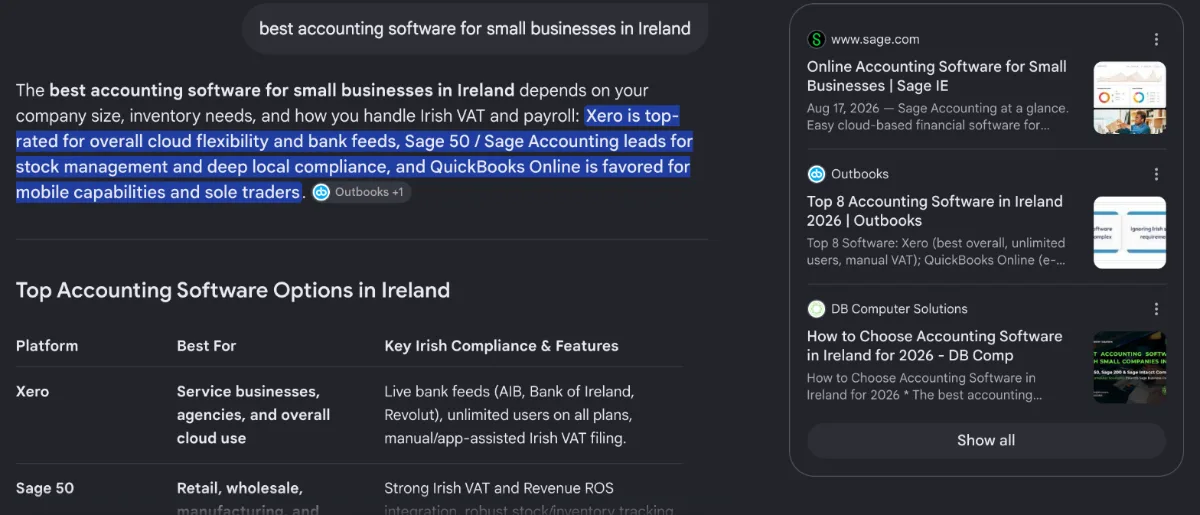
Content is highly extractable when:
- The direct answer to the implied question appears in the first paragraph, not buried three sections deep
- Headings accurately describe what each section answers (specific and descriptive rather than creative, vague, or clever)
- Key facts are presented in lists, tables, or short paragraphs rather than dense narrative
- Visible Q&A sections use exact question phrasing that matches how customers actually ask questions (the visible text is what counts; FAQ markup is optional)
- Specific details are stated plainly: prices, hours, locations, qualifications, turnaround times
Content is poorly extractable when it builds to an answer over several paragraphs, uses industry jargon without explanation, buries key facts in long paragraphs, or uses headings that describe the writer's structure rather than the reader's question.
Signal 2 · Authority: is this source credible enough to cite?
AI systems are designed to avoid citing low-quality, untrustworthy, or unverifiable sources. Before citing a page, the system evaluates whether the source is credible. The authority signals that matter for AI citation are partly overlapping with traditional SEO but weighted differently.
Named entity consistency
Your business name, location, contact details, and sector should appear consistently across your website, Google Business Profile, Companies Registration Office listing, and any industry directories. AI visibility studies associate stable results with consistent naming and description across every source. Consistency tells AI assistants that the business is real, established and verifiable.
Organisation identity on the website
An About page with your business name, founding information, team names, and professional credentials is one of the clearest trust signals for AI systems. Anonymous content (pages with no clear author, no organisation identity, no contact details) is treated with lower confidence.
Mentions on credible sources, linked or not
Being mentioned by reputable sites in your sector or local area matters more than the link itself. In Ahrefs’ study of 75,000 brands, unlinked brand mentions correlated with AI visibility at about 0.66, against about 0.22 for backlinks. A solicitor listed in the Law Society of Ireland directory, or a restaurant reviewed in a regional food publication, gives the AI assistant a source that vouches for it.
Professional credentials and associations
Regulatory body memberships, professional certifications, and industry association affiliations improve AI trust evaluation when they are stated clearly on your website with verifiable details. A solicitor who lists their Law Society roll number, or an electrician who states their Safe Electric registration, gives AI systems information they can cross-reference.
Signal 3 · Query match: how precisely does this page answer the question?
AI search queries tend to be far more specific and conversational than traditional search queries, often full questions rather than a few keywords. This specificity is actually an opportunity for local businesses, because highly specific queries often have fewer competing sources, and a page that addresses the exact question asked will be preferred over one that covers the topic generally.
A page titled "Family law solicitors in Cork" is competing against every family law page for every Cork solicitor. A page that answers "What happens to the family home when you divorce in Ireland, and how do you find a solicitor to help?" is targeting a specific query that very few pages answer directly, which gives a local solicitor a genuine opportunity to be the cited source.
The content strategy implication is clear: build pages around the specific questions your customers ask AI, not just around the keywords they use in traditional search. Each page should target one question, answer it in the first paragraph, and develop the answer in structured sections below.
Signal 4 · Recency: is this information current?
AI assistants lean heavily on maintained pages. Seer Interactive found in July 2026 that 75% of 7,683 cited pages had been updated within the last year. More than a quarter of those pages were first published two or more years earlier: they stayed current because someone maintained them, not because someone changed the date.
For local businesses, this means:
- Showing an honest "Last updated: [date]" line on your key service pages, changed only when the content changes
- Updating pages when prices, hours, services, or other details change
- Reviewing your most important pages on a schedule and making real updates, not cosmetic ones
- Keeping any
dateModifiedin your schema honest and matching the visible date (it is hygiene, not a ranking trick)
How these signals combine: a practical example
Consider two Galway restaurants. Both have websites. A customer asks ChatGPT: "What's the best restaurant in Galway for a large family birthday dinner, ideally with a private dining area and a children's menu?"
Restaurant A has a homepage that says "Award-winning dining in the heart of Galway." The menu is a PDF. There is no mention of private dining or children's options anywhere on the site. OAI-SearchBot, the crawler that builds ChatGPT's search index, is blocked in their robots.txt.
Restaurant B has a page titled "Private dining and group bookings in Galway." The first paragraph reads: "We offer a private dining room for up to 30 guests, suitable for family celebrations and birthday parties. Our children's menu includes [specific items]. Tables for groups of 10 or more can be reserved by phone or email." The page has a visible question-and-answer section on group bookings, and the restaurant updated the menu and prices on it this month. Local food writers and its Google Business Profile describe it the same way.
Restaurant B is far more likely to be cited. Restaurant A cannot be, for several reasons at once. This illustrates why a comprehensive approach across all four signals is more effective than optimising for just one.
Frequently Asked Questions
Why does AI search cite some businesses and not others in the same sector?
AI search systems cite businesses whose websites provide clear, directly extractable answers to the question being asked. A business with a well-structured page that opens with a direct answer and includes specific details, and that is talked about on the review sites, roundups and press the assistant already trusts, is more likely to be cited than a competitor with a generic page, even one with a larger website or more backlinks. Schema markup on its own has shown no measurable effect.
Do AI search systems favour larger websites?
Larger websites with strong authority do have an advantage for general queries. However, local and niche specificity levels the playing field. A local restaurant with a well-structured page answering a specific local query may be cited ahead of a national dining guide that covers the topic more generically. Specificity beats size for specific queries.
How important is being up-to-date for AI search citations?
Very. Seer Interactive found in July 2026 that 75% of pages cited by AI assistants had been updated within the last year, and many of them were years old but maintained. What counts is a real update to the content, such as new prices, hours, services or rules. Changing only the date does not.
Does having more content help with AI citations?
Quality and directness matter far more than volume. A single well-structured page that answers a specific question clearly will be cited more reliably than ten longer pages that mention the topic without addressing it directly. Build a library of focused, answer-first pages (each targeting one specific question) rather than producing high volumes of general content.