To appear in Google AI Overviews, your pages must be indexed by Google and eligible to show with a snippet. Google confirms there is no separate opt-in and no special markup. Then answer specific questions directly at the top of the page, keep those pages genuinely maintained, and get your business named on the sources Google already cites: your Google Business Profile, review sites, roundups and local or trade press. Schema markup is hygiene, not a lever. Ranking well helps, but in 2026 most citations come from pages outside the top ten.
What are Google AI Overviews and why do they matter?
Google AI Overviews are AI-generated summaries that appear at the very top of Google search results, above all the ranked blue-link pages (only ads sometimes appear higher on commercial searches). They synthesise content from multiple websites and present a combined answer, with source links displayed alongside or below the summary.
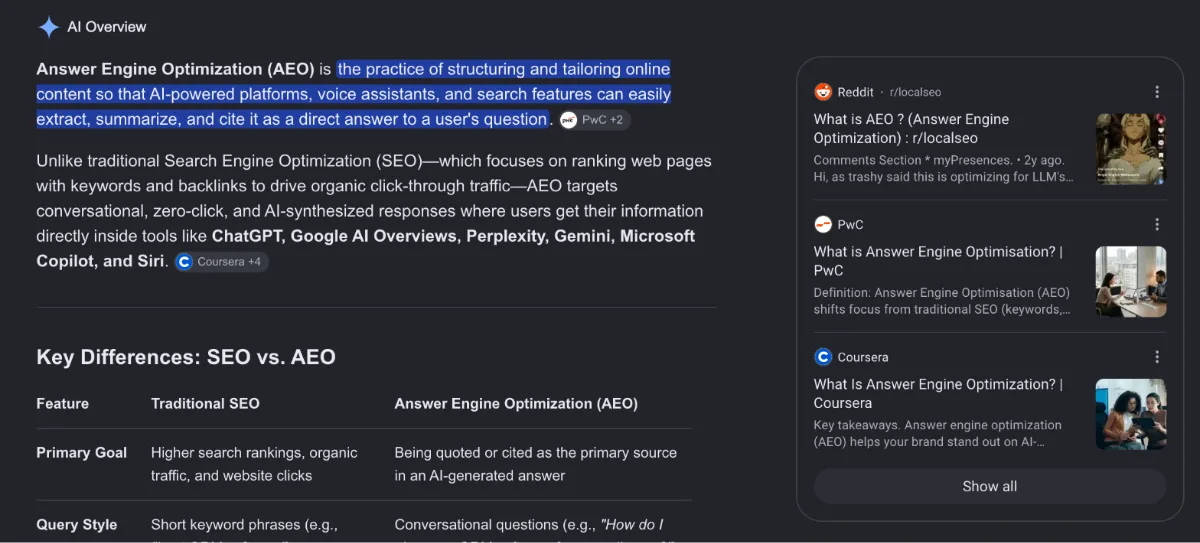
When an AI Overview appears for a search query, it can sharply cut click-through to the ranked pages below it. A 2025 Pew Research study found people clicked a traditional result on only 8% of searches that showed an AI summary, versus 15% of searches without one. The AI Overview captures the user's attention, answers their question, and in many cases, they do not scroll further. If your business is cited in the Overview, you receive a mention and a link. If you are not cited, you are effectively invisible for that query, even if you rank in position one below it. Ahrefs found in May 2026 that the top result loses 58% of its clicks when an AI Overview appears, while Seer Interactive found cited pages get 120% more clicks per impression than uncited ones.
This makes appearing in AI Overviews one of the most commercially significant opportunities in search marketing right now. Being cited in an AI Overview for a competitive local query can easily carry more value than ranking third in the blue links below it.
Step 1: Make sure Google can index and show your pages
There is no separate crawler to allow for AI Overviews. Google's own documentation is clear: to be eligible, a page needs to be indexed by Googlebot and eligible to appear in Google Search with a snippet. There is no special file, no special markup, and no separate opt-in.
Your robots.txt should not block Googlebot:
Two things commonly knock sites out of AI Overview consideration: pages that are not indexed at all, and snippet restrictions. If your pages use nosnippet, data-nosnippet, or a restrictive max-snippet rule, Google cannot quote them, which removes them from AI Overviews too.
You may also see Google-Extended mentioned in AI advice. It is a robots.txt control that decides whether Google can use your content for Gemini training and for grounding answers in the Gemini app. Google says it does not affect Search, so it changes nothing for AI Overviews or AI Mode (Google). Blocking it does remove you from Gemini's answers, so it is not a free choice.
Step 2: Structure content for AI extraction
Google's AI Overview system selects sources based on how well their content answers the specific sub-questions within a query. Google has confirmed it uses a "query fan-out" approach: breaking complex queries into multiple sub-questions, searching for the best answer to each, and synthesising the results into an Overview.
Your content needs to answer specific sub-questions clearly. The structure that works is:
- Direct answer in the first paragraph: state the answer before providing context or background
- Descriptive h2 headings that match the sub-questions users ask (e.g. "How long does conveyancing take in Ireland?" not "Our process")
- Specific, factual content: hours, prices, addresses, qualifications, step counts, timeframes
- A visible Q&A block with exact phrasing that matches how customers ask questions. The visible text is what Google reads; FAQ markup is optional
- Self-contained answers: each section should make sense if quoted on its own. Google says there is no need to break content into tiny pieces, so write for the reader, not for a machine.
Step 3: Keep schema markup accurate, but treat it as hygiene
Earlier versions of this guide treated schema as a key step. The evidence no longer supports that. Google says "there's no special schema.org structured data" you need for AI features (Google), and a controlled Ahrefs test on 1,885 pages that added JSON-LD found no positive effect on AI citations (May 2026). Keep accurate schema as cheap hygiene:
- FAQPage schema: optional. What helps is the visible questions and answers on the page; if you add the markup, it must match the visible text exactly.
- LocalBusiness schema: states your name, address, phone and hours. Keep it consistent with your Google Business Profile, which carries far more weight for local answers.
- Article schema: for guide pages, records the author and the published and updated dates. The dates must reflect real updates, not a changed timestamp.
- Service schema: optional; describes individual services. Clear service pages in plain HTML matter more.
If your site uses WordPress, plugins like Yoast SEO or Rank Math add basic schema automatically, and that is enough. Do not buy an "AI schema" package. Spend the time on Step 4 and on getting your business named by the sites Google already cites: for local businesses, the Google Business Profile is 28.6% of local AI citations (BrightLocal, September 2026).
Step 4: Build pages targeting AI Overview query types
Not all queries trigger AI Overviews. Google is more likely to generate an AI Overview for queries that are:
- Informational or research-oriented ("how does X work", "what is Y", "how do I Z")
- Complex or multi-part ("plan a trip to Killarney for 4 adults with a budget of €500")
- Comparative ("best family solicitor in Cork vs Dublin")
- Local with specific requirements ("gluten-free restaurant Galway open Sunday evening")
Queries with clear commercial intent ("book hotel Cork") are less likely to trigger an AI Overview and more likely to show booking ads and the local pack. Focus your AI Overview optimisation on the informational and research-phase queries. These are where customers are deciding who to contact, and being cited gives you brand visibility at the highest-impact moment of their decision journey.
Step 5: Monitor and track AI Overview appearances
Tracking AI Overview citations is currently less straightforward than tracking traditional rankings, but there are practical approaches:
- Manual searches. Conduct regular searches for your key queries and check whether AI Overviews appear and whether your business is cited. Do this in a private/incognito browser to avoid personalisation effects.
- Analytics. Visits from AI Overviews and AI Mode stay in Organic Search in GA4. They are not part of its AI Assistant channel (Google), so watch visits to specific answer pages instead.
- Google Search Console. Since 31 August 2026, the Generative AI performance report shows your impressions in AI Overviews and AI Mode by page, country, date and device (Google). It shows no clicks or queries, and it does not separate the two features.
- Bing Webmaster Tools. Not for AI Overviews, but worth setting up at the same time: its AI Performance report shows a sample of your citations in Copilot and Bing's AI summaries.
AI Overviews checklist for local businesses
- Googlebot is not blocked, key pages are indexed, and no nosnippet or max-snippet rules restrict them
- XML sitemap is submitted to Google Search Console
- Key pages open with a direct answer in the first paragraph
- h2 headings match exact natural-language questions from customers
- Pages with questions carry a visible Q&A block with self-contained answers (markup optional)
- Your business is named on the sources Google already cites: reviews, local roundups and press
- Google Business Profile is complete and matches website information
- At least 5 pages target informational or research-phase queries in your sector
- Pages are genuinely updated, not just redated, and show honest published and updated dates
- Search Console's Generative AI report and manual checks of key queries are reviewed monthly
Frequently Asked Questions
What are Google AI Overviews?
Google AI Overviews are AI-generated summaries that appear at the top of Google search results, above all blue-link results. They synthesise content from multiple websites and present a combined answer with source citations. When an AI Overview appears for a query, it can sharply cut click-through to the ranked pages below.
Do I need to rank in Google to appear in AI Overviews?
Not necessarily. Google selects AI Overview sources based on content quality, answer structure, and authority signals, not purely on ranking position. A 2026 Ahrefs study of 863,000 searches found only 38% of AI Overview citations came from pages ranking in the top ten for the same query. A page that does not rank in the top ten can still be cited if its content is well-structured, directly answers the question, and is indexed and eligible to show with a snippet.
Does blocking Google-Extended affect my regular Google rankings?
No. Google-Extended is a robots.txt control, separate from Googlebot, and Google says it does not affect Search. It does not remove you from AI Overviews or AI Mode, which use the standard Google index. It does stop Google using your content for Gemini training and for grounding Gemini app answers, so blocking it removes you from Gemini. To stay out of AI Overviews you would need snippet controls such as nosnippet.
Can small local businesses appear in Google AI Overviews?
Yes. Local businesses appear in AI Overviews frequently for location-specific queries. A local hotel with a detailed page on pet-friendly accommodation in their area may be cited in an AI Overview ahead of larger national booking platforms, simply because its content is more specific, more local, and better structured for extraction.
How can I tell if my business is appearing in AI Overviews?
Open the Generative AI performance report in Search Console, available since 31 August 2026: it shows your impressions in AI Overviews and AI Mode by page, without clicks or queries. Then search your key queries in a private browser window each month, several times each, because answers vary between runs. Record whether an AI Overview appears and whether you are cited.