
To get Google reviews that improve AI citation, ask real customers for reviews immediately after a completed service, make the review process effortless with a direct link or QR code, and guide customers to mention the specific service, location and outcome in their own words. For a local business, your Google Business Profile is the second biggest source of AI citations after your own website: it receives 28.6% of local AI citations (BrightLocal, September 2026). The goal isn't simply more reviews, but a steady flow of recent, detailed and genuine reviews that confirm what you do and where you do it.
Google reviews help AI search systems verify who you are, what you do and whether people trust you.
Google reviews aren't just a star-rating signal for traditional local search anymore. They also act as public evidence. When AI search systems put together answers about the best solicitor in Cork, a reliable accountant in Galway, a boutique hotel in Kerry or a recommended restaurant in Dublin, they look for clear, repeated signals across the web. Review profiles are among the sources they cite most. In BrightLocal's study of 1.97 million local AI citations (September 2026), Google Business Profile received 28.6%, second only to businesses' own websites. Yelp received 9.5%, Facebook 2.2% and Tripadvisor 1.8%.
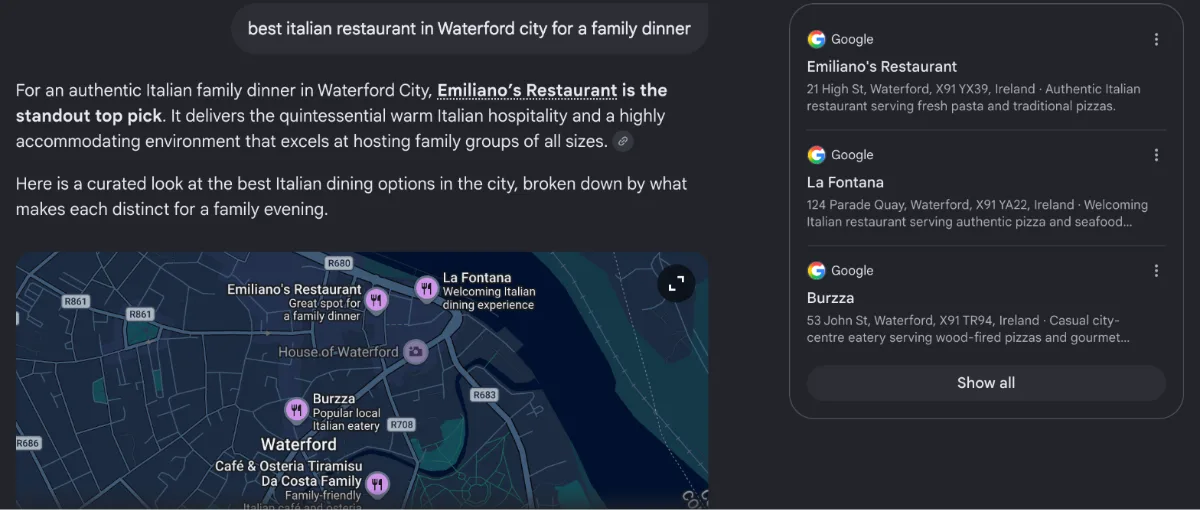
That matters because AI systems don't cite businesses only because a website claims expertise. They tend to favour sources and entities that appear consistently trustworthy. A business with recent, specific and relevant Google reviews is easier to understand and easier to recommend. Reviews can reinforce your service categories, your location, your specialisms and your reputation for outcomes.
If you want to understand the broader mechanics behind this, see How ChatGPT Search selects which sources to cite. Reviews fit into that wider picture by strengthening credibility and entity clarity.
The reviews that support AI citation are specific, recent and naturally written.
Not all reviews carry the same value. A short review saying “Great service” is better than nothing, but it gives very little context. A review saying “We used this firm for conveyancing in Limerick and they kept the process clear and on schedule” is much more useful. It tells both humans and AI systems what happened, where it happened and why the customer was satisfied.
Specific reviews describe the service provided.
The most useful reviews mention the actual service: family law, tax returns, Sunday lunch, wedding venue coordination, bespoke fittings, payroll support or emergency plumbing. This language helps confirm your commercial relevance for those topics.
Recent reviews show the business is active and still trusted.
A strong review profile isn't built on a burst of activity from two years ago. Recency counts for more than the total: review recency is rising in Whitespark's 2026 local ranking factors survey. A steady flow of genuine reviews is better than occasional spikes.
Naturally written reviews are more credible than templated ones.
Customers should never be told what exact words to use. Instead, prompt them with themes. Encourage them to mention what service they used, what problem they had and what stood out. Genuine variety in wording looks more trustworthy than a series of near-identical reviews.
The best time to ask for a Google review is immediately after a successful outcome.
Timing has a direct effect on review volume and quality. The ideal moment is when the customer has just experienced the value of your service and the details are still fresh. For a solicitor, that may be when a transaction completes. For a restaurant, it may be just after the meal. For a hotel, on check-out or the morning after departure. For an accountant, after a filing deadline is successfully met. For a boutique retailer, shortly after delivery or collection.
When you wait too long, response rates fall and reviews become more vague. Immediate requests produce more accurate descriptions and stronger emotional recall.
Match the request to the customer journey.
Different businesses need different moments. A hotel shouldn't ask before the guest has experienced the stay. A law firm shouldn't ask during a stressful unresolved matter. A restaurant can ask on the day; an accountant may need to ask after the result is delivered.
Use staff prompts, not just automated systems.
Automation helps, but a personal request often performs better. A receptionist, partner, manager or front-of-house team member can say, “If you were happy with the service, we'd really appreciate a Google review. I can text you the link now.” That simple moment often increases completion rates.
Making the review process easy is the fastest way to increase review volume.
Most satisfied customers don't leave reviews because the process feels inconvenient, not because they are unwilling. Your job is to remove friction. If a customer has to search for your business, guess which profile is correct or navigate too many steps, many will abandon the task.
Use a direct Google review link.
Create a direct review URL for your Google Business Profile and use it everywhere: email signatures, SMS follow-ups, printed cards, receipts and thank-you pages. One tap should take the customer to the review screen.
Use QR codes in physical locations.
Restaurants, hotels, boutiques and reception-based professional firms can benefit from discreet QR codes. Place them where the customer has a moment to act: at the till, reception desk, in a guest room folder, or on a takeaway insert. The code should lead directly to the review form, not your homepage.
Keep the ask short and polite.
A simple request works best. For example: “Thank you for choosing us. If you found the service helpful, we'd be grateful if you could leave a quick Google review here.” Long explanations reduce action.
The wording of your request should encourage useful detail without scripting the customer.
You should never write the review for the customer or pressure them to include certain claims. However, you can encourage better reviews by prompting them to reflect on their experience. This improves review quality while staying ethical and compliant.
Ask for detail, not praise.
Instead of saying “Please leave us a five-star review”, say “If you have a minute, it would help if you could mention the service you used and what stood out.” This leads to more informative reviews and avoids manipulative language.
Prompt for service, location and outcome.
These three elements are especially useful for AI citation. Service explains what you do. Location confirms local relevance. Outcome shows competence. A review such as “The team handled our employment contract review in Cork quickly and clearly” is far more valuable than “Very professional”.
Use channel-appropriate templates.
An SMS request should be brief. An email can include a little more guidance. An in-person request should feel conversational. The key is consistency across channels without sounding robotic.
Review quality improves when your business operations are review-ready.
Businesses often focus on the ask and ignore the experience that produces the review. The strongest review strategy starts before the request. If your staff are slow to respond, your invoices are confusing or your handover process is weak, customers will struggle to describe a positive experience in specific terms.
Clarify your service categories.
Customers use the language they hear from you. If your firm consistently describes its work as probate, conveyancing, payroll, tasting menu dining or bridal alterations, customers are more likely to repeat those terms in reviews.
Create memorable proof points.
People write better reviews when they can recall a distinct positive detail: quick communication, clear advice, smooth check-in, thoughtful recommendations, punctual delivery or excellent aftercare. These become the phrases that strengthen your public reputation.
Train frontline staff to ask confidently.
Staff should know when to ask, how to ask and how to send the link. A review strategy fails when it depends on one owner remembering occasionally. It works when the whole team treats it as part of service follow-up.
Replying to reviews strengthens trust signals and improves profile quality.
Responses matter because they show the business is active, attentive and accountable. They also let you reinforce service language naturally. A thoughtful response can confirm the service provided and the business’s professionalism without sounding promotional.
Thank positive reviewers with specific language.
Instead of “Thanks for your review”, say “Thank you for trusting us with your conveyancing matter in Cork” or “We're delighted you enjoyed your weekend stay and breakfast.” This helps reinforce relevance while remaining natural.
Handle negative reviews calmly and professionally.
No legitimate business has perfect feedback forever. A measured response to criticism can improve trust more than silence can. Acknowledge the issue, avoid defensiveness and invite offline resolution. Future customers and AI systems both interpret this as a sign of a real, managed business.
Do not over-optimise your responses.
Review replies should sound human. Repeating service keywords unnaturally or posting formulaic responses can weaken credibility. Use plain language and respond as a professional, not as a marketer.
Incentivised, fake or gated reviews can damage trust and should be avoided.
If your aim is better AI citation, credibility is everything. Buying reviews, offering rewards only for positive reviews or filtering unhappy customers away from Google may produce a temporary appearance of success, but it creates long-term risk. AI search systems and human users both reward authenticity.
Do not offer gifts in exchange for positive reviews.
This can breach platform policies and undermines trust. If discovered, it can damage your reputation more than a low review count ever would.
Do not ask only happy customers while blocking others.
Review gating creates a distorted profile. A healthy profile contains a realistic mix of sentiment, with strong overall quality and visible business responses.
Do not use staff, friends or fabricated accounts.
False reviews are often easy to spot. Even when they remain live for a period, they weaken the reliability of your brand footprint.
A repeatable review system produces better results than occasional campaigns.
The businesses most likely to be surfaced in AI answers usually have stable, repeatable reputation signals. That means your review process should be operational, not ad hoc. Build it into your weekly routines and assign responsibility for it.
Set a monthly review target by service line.
A hotel may target reviews from leisure guests and wedding guests separately. An accountancy practice may want reviews for bookkeeping, tax and advisory work. This creates a broader and more representative profile.
Track review themes, not just star ratings.
Look for repeated phrases customers use. These often reveal how the market actually perceives you. If reviewers repeatedly mention “clear communication”, “excellent wine list”, “fast turnaround” or “patient advice”, those are trust assets worth reinforcing elsewhere on your site and profiles.
Connect reviews to your wider AI search presence.
Reviews work best when they align with your website, service pages and business profile. If your site says you specialise in employment law in Dublin, but your reviews only mention generic legal help, there is a missed opportunity. Consistency across sources helps AI assistants describe you correctly. Google is not the only platform they read, either: restaurants and hotels should also keep Tripadvisor and Yelp current, most local businesses Facebook, retailers Trustpilot, and B2B software firms G2 and Gartner Peer Insights.
This is also where a structured approach such as an AI Visibility Audit or AEO Implementation Programme becomes useful. Reviews are one part of a broader discoverability system, not a standalone tactic.
A practical review request process can be implemented in one week.
You don't need a complex technical project to improve review signals. Most local businesses can make meaningful progress quickly by standardising the request, simplifying the path and training staff.
- Claim and fully complete your Google Business Profile with correct name, address, phone number, categories and opening hours.
- Create a direct Google review link and test it on both mobile and desktop.
- Generate a QR code that points directly to the review form.
- Decide the best review request moment for each service type or customer journey.
- Write one SMS template, one email template and one in-person script for staff.
- Ask customers to describe the service they used, the location and what result they received, in their own words.
- Train reception, front-of-house or account managers to send the review link immediately after a positive outcome.
- Place QR codes on printed materials only where customers can act comfortably and without pressure.
- Assign one team member to monitor new reviews and respond within a few days.
- Record monthly review volume, average rating and common phrases mentioned by customers.
- Use recurring review themes to improve service page wording and local business descriptions.
- Avoid incentives, fake reviews and any process that filters out dissatisfied customers.
The businesses most often cited by AI search systems usually look consistently trustworthy across reviews, website content and local profiles.
If you want more visibility in AI search, think beyond stars. Google reviews help create a public record of customer experience. When those reviews repeatedly confirm your service quality, specialism and location, they become powerful evidence. That evidence supports citation because it helps AI systems answer practical user questions with confidence.
For a solicitor, that may mean reviews that mention probate, conveyancing or employment advice in a specific county. For a restaurateur, it may mean consistent mentions of atmosphere, service and signature dishes. For an accountant, it may mean trusted support through tax deadlines. For a hotel manager, it may mean repeated proof of cleanliness, hospitality and event coordination. For a boutique owner, it may mean personal service, product quality and smooth delivery.
The principle is the same in every case: make it easy for real customers to leave honest, detailed reviews at the right moment, then manage those reviews professionally. That's how review generation becomes an AI citation asset rather than just a reputation metric.
How many Google reviews do I need to help AI citation?
There is no fixed number. Recency and detail matter more than a headline total: review recency is rising in local ranking-factor surveys, and forty reviews that are all two years old make a business look inactive. Aim for a steady flow every month rather than one-off bursts.
Do star ratings matter as much as review text?
Both matter, but review text is especially useful because it explains the service, location and customer experience in natural language. Strong star ratings help establish trust, while detailed written reviews provide the context that supports discoverability and citation.
Should I ask customers to mention my town or service in their review?
You can encourage customers to mention the service they used and where you helped them, but you should not script exact wording. A polite prompt such as “It helps if you mention the service you used” is appropriate. The review should remain in the customer’s own voice.
Can replying to Google reviews improve my visibility in AI search?
Replying can help indirectly by showing that your business is active, professional and engaged. Good responses also reinforce service relevance naturally. They are not a substitute for earning strong reviews, but they strengthen the overall trust profile of your business.
What if my business gets a negative review?
A negative review doesn't automatically harm your chances if you handle it well. Respond calmly, acknowledge the issue and offer to resolve it offline. A profile with authentic reviews and professional responses often appears more credible than one that looks artificially perfect.