Off-site authority matters for AI citation because AI search systems often trust independent sources more than a business’s own website when deciding what to mention, recommend or cite. Since most AI citations come from third-party sources (84% are earned media in Muck Rack’s May 2026 analysis), the practical meaning is straightforward: your visibility in AI results depends not only on what your site says about you, but on whether respected directories, review platforms, trade bodies, local press, mapping platforms and industry publications consistently confirm the same facts. Businesses that appear across credible external sources with accurate, repeated signals are more likely to be cited than businesses with a polished website but weak independent validation.
Third-party validation is the strongest signal for AI visibility
Traditional search taught businesses to focus heavily on their own website. That still matters, but AI search systems work differently. They don’t only rank pages. They assemble answers. To do that safely, they look for corroboration. Muck Rack’s analysis of 25 million citations across ChatGPT, Claude and Gemini (May 2026) found 84% were earned media, journalism alone 27%. Press releases were 1.1% and paid placements 0.3%, so coverage has to be earned, not bought.
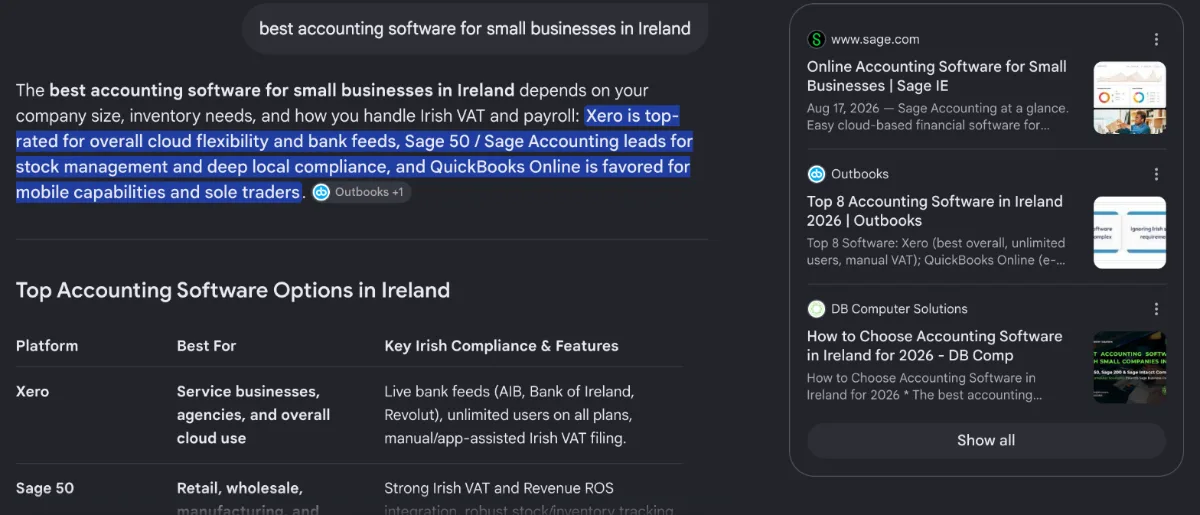
For a solicitor, that may mean checking legal directories, review platforms, local listings and professional bodies. For a restaurant, it may mean comparing your website with Google Business Profile, reservation platforms, review sites, food guides and local press coverage. For an accountant, it may mean matching your stated services and location against directory profiles, association memberships and trusted business databases.
When AI systems see the same business facts repeated across multiple reputable sources, confidence increases. When they see gaps, contradictions or no external footprint at all, confidence falls. In practice, that affects whether your business is cited directly, mentioned as an option, or ignored in favour of a competitor with stronger external proof.
Your own website is the claim, but third-party sources are the evidence
Your website can say you are award-winning, highly rated, centrally located, specialists in a field, or one of the best options in your area. AI systems treat those statements as self-published claims. Third-party sources act as evidence that those claims are real.
This is especially important in local and professional services, where users ask high-trust questions such as “best family solicitor in Cork”, “top boutique hotel in Galway for couples”, or “reliable accountant for small business in Dublin”. In these cases, AI systems prefer signals that come from outside the business itself.
Off-site authority is built from consistency, credibility and coverage
Businesses often assume off-site authority means “getting backlinks”. The data says that is the weak part. In Ahrefs’ study of 75,000 brands (December 2025), brand mentions correlated with AI visibility at about 0.66, backlinks at about 0.22, and YouTube mentions at about 0.74, the strongest factor measured. For AI citation, off-site authority is the combined strength of your external footprint.
That footprint is made up of three elements: consistency of business facts, credibility of the source, and coverage across the places AI systems are likely to reference.
Consistency means your business details match across the web
Your business name, address, phone number, opening hours, service descriptions and category should align across your website and key external listings. Even small differences can weaken confidence. A hotel listed under one brand variation on its website, another on a booking platform and a third on a local directory creates ambiguity. The same applies to firms using inconsistent service descriptions such as “commercial law” in one place and “business legal support” in another.
AI assistants repeat their sources, so a wrong category or an old name in one listing can end up in an answer. Consistency helps them understand that all references point to the same business.
Credibility means the source itself is trusted
Not all mentions carry equal weight. A respected trade association, established review platform, government register, recognised local newspaper or major mapping service is more influential than a low-quality directory no one uses. AI systems are more likely to rely on sources that have editorial standards, user trust and a history of accurate information.
For local businesses, this means quality matters more than volume. Ten strong, relevant third-party sources are more useful than fifty weak ones.
Coverage means appearing where your category is normally verified
Different sectors have different authority sources. Restaurants need strong presence on maps, reservations, reviews and food coverage. Solicitors need legal directories, review profiles, local credibility and professional affiliations. Hotels need booking platforms, travel reviews, local tourism references and press mentions. Accountants need business directories, professional memberships and local trust signals.
AI systems compare you against category expectations. If your competitors appear across the normal trusted sources for your sector and you do not, you are less likely to be surfaced.
Local businesses are judged by external proof before they are recommended
AI search systems are increasingly used for recommendation-style queries. People ask for the best, nearest, most reliable, most suitable or highest-rated option. That changes the visibility game.
To answer these queries, AI systems need confidence not just that your business exists, but that it is recognised by others. A boutique owner may have a beautiful site, but if there are no trusted local mentions, no review signals and no directory consistency, AI systems have little basis for recommending the shop. A restaurateur may have excellent menus online, but patchy reviews, outdated listings and inconsistent opening hours make citation less likely.
This is one reason off-site authority often has more influence than businesses expect. It bridges the gap between “we say we are good” and “the web agrees we are a credible option”.
Professional services need stronger trust signals than low-risk purchases
For solicitors and accountants, the threshold is higher. Users are making decisions involving money, legal matters, compliance or personal risk. AI systems are therefore more cautious. They are more likely to rely on sources that demonstrate legitimacy, expertise and reputation.
That means your off-site footprint should include more than a generic directory listing. It should include professional memberships, authoritative profiles, reviews where appropriate, local media references, speaking engagements, awards with traceable sources and citations from relevant organisations.
AI citation depends on entity clarity, not just domain strength
Many businesses think authority is mainly about the power of their website domain. In AI search, entity clarity is equally important. An entity is the identifiable business itself: who you are, what you do, where you operate and why you are relevant.
If AI systems can clearly connect your website, your Google Business Profile, your reviews, your directory listings, your press mentions and your trade memberships to one coherent business entity, citation becomes easier. If those signals are fragmented or contradictory, citation becomes harder.
This is why off-site authority is not separate from on-site optimisation. Your site should reinforce the same business facts, service categories and location signals found elsewhere online. Each AI assistant reads a different index: ChatGPT has run its own search index since September 2026, while Copilot still uses Bing. Our guide on Bing, ChatGPT and Copilot explains what changed.
Mentions without links can still matter
In classic SEO, businesses often focused on whether a mention included a clickable link. For AI assistants, the mention itself is what correlates with visibility: unlinked mentions on credible sources tracked AI visibility three times more closely than backlinks in the Ahrefs study.
If a local paper lists your hotel among recommended weekend stays, or a chamber of commerce includes your accountancy practice in a member directory, that can contribute to authority even if the reference is not a perfect traditional backlink.
The strongest third-party sources are usually practical, local and sector-specific
Businesses do not need national press coverage to improve AI citation. In most cases, the best gains come from strengthening the sources that already shape local trust.
Core sources for most local businesses
Start with Google Business Profile. BrightLocal’s September 2026 study of 1.97 million local AI citations found 28.6% pointed to Business Profiles, more than any source except businesses’ own websites; Yelp took 9.5%, Facebook 2.2% and Tripadvisor 1.8%. Then established review platforms, local directories, chamber listings and reputable local news. Bing Places and Apple Business Connect are cheap to claim and feed Copilot and Siri, though no study has measured their effect yet.
Sector sources add depth and credibility
A solicitor may benefit from legal directories and law society references. A restaurant may benefit from reservation platforms, food review sites and local dining round-ups. A hotel may benefit from tourism listings, booking sites and travel publications. An accountant may benefit from professional directories, business associations and specialist finance publications. For B2B software, five platforms take 88% of review-site citations in Google’s AI Overviews: Gartner Peer Insights, G2, Capterra, Software Advice and TrustRadius (SE Ranking, January 2026). “Best of” roundups matter in every sector: they are the most-cited page type for comparison questions.
The right mix depends on your sector, but the principle is the same: be present where a credible observer would expect to find evidence of your business.
Weak off-site signals create three common citation problems
When businesses are not cited by AI systems, the issue is often not a lack of website content alone. It is usually one of three off-site authority problems.
Problem one: the business is hard to verify
This happens when listings are incomplete, inconsistent or missing. AI systems may struggle to confirm your location, category, service area or current status.
Problem two: the business is visible but not corroborated
This happens when your website makes strong claims but independent sources do not support them. You may describe yourself as a leading local provider, but there are no reputable external mentions, review signals or recognised profiles to back that up.
Problem three: competitors have stronger external proof
Even if your information is accurate, you may be outranked in AI answers by competitors who are more extensively referenced elsewhere. AI systems are comparative. If one restaurant has consistent listings, strong review signals, local press mentions and booking platform presence, while another only has a website, the first is more likely to be recommended.
A practical off-site authority checklist for AI citation
Businesses can improve AI visibility by treating off-site authority as an operational discipline rather than a one-off SEO task.
- Audit your business name, address, phone number and website URL across all major listings and correct every inconsistency.
- Claim and fully complete your Google Business Profile first, then Bing Places and Apple Business Connect.
- Add accurate service descriptions that match the wording used on your website and reflect how customers actually search.
- Ensure opening hours, booking details and contact information are current across every platform.
- Prioritise high-trust directories and sector-specific platforms over low-quality bulk listings.
- Build profiles on professional bodies, trade associations and membership organisations where relevant.
- Encourage genuine customer reviews on the platforms that matter most in your sector.
- Respond professionally to reviews so external sources show active business management.
- Get onto the “best of” roundups and local press the AI assistants already cite for your category. Pitch stories, not press-release wires.
- Answer questions in the community threads your customers read, openly as the business. Reddit is a strong source for Google AI Mode and Perplexity, though no longer for ChatGPT since August 2026.
- Check that your website clearly matches your off-site profiles in branding, services, location and contact details.
- Publish a long-form explainer video on YouTube with your business named in the title and a full description.
- Review citation quality quarterly rather than assuming listings stay accurate on their own.
On-site content and off-site authority work best together
Off-site authority is not a replacement for strong website content. It amplifies it. Your website still needs clear service pages, location relevance, structured business information and concise answer-first copy that AI systems can extract. External sources then reinforce those claims.
That is why the best results usually come from combining technical clarity, factual consistency and answer-focused content with an organised third-party authority strategy. At HelloWorld, this is typically addressed through an AI Visibility Audit, followed by foundational fixes and ongoing authority building through our AEO Implementation Programme, AI Answer Content and AEO Retainer services.
Authority building should follow business priorities
Not every mention has the same commercial value. A hotel may prioritise travel platforms and tourism references before broad directories. A solicitor may prioritise legal credibility and local trust sources before lifestyle coverage. An accountant may focus on professional validation and local business visibility. The right off-site plan follows the way clients choose providers in your category.
The practical takeaway is simple: if others do not confirm you, AI systems may not cite you
For local businesses, the lesson is straightforward. AI search systems are increasingly cautious about relying only on self-published claims. They prefer businesses that are easy to verify, consistently described and independently recognised.
If 84% of citations are earned, then off-site authority is not a supporting tactic. It is part of the core infrastructure of AI visibility. Businesses that want to appear in AI answers should treat directories, reviews, press mentions, trade profiles and map listings as citation assets, not admin tasks.
The businesses that win in AI search are usually the ones whose reputation is visible beyond their own website.
What counts as a third-party source for AI citation?
A third-party source is any credible website or platform that is not your own, such as directories, review sites, map listings, trade bodies, booking platforms, local news sites, industry publications and professional associations. These sources help AI systems verify your business independently.
Do I need backlinks, or do brand mentions help as well?
Brand mentions matter more. In Ahrefs’ study of 75,000 brands, mentions on the web correlated with AI visibility at about 0.66 and backlinks at about 0.22. A mention on a trusted source that clearly identifies your business helps whether or not it links to you.
Which third-party platforms matter most for local Irish businesses?
Google Business Profile first: it receives 28.6% of local AI citations in BrightLocal’s September 2026 study. Then the review sites for your sector (Yelp, Tripadvisor, Facebook), relevant local directories, sector-specific platforms, “best of” roundups and reputable local media. The exact mix depends on your industry and location.
Can a small business compete with larger brands in AI search?
Yes. Local relevance, accurate listings, strong reviews, sector credibility and consistent third-party validation can make a smaller business highly citable for local and specialist queries, even when larger brands have bigger websites.
How do I know if weak off-site authority is limiting my AI visibility?
Common signs include inconsistent listings, missing profiles on key platforms, few independent mentions, weak review presence and competitors appearing more often in AI-generated recommendations. A structured audit is the fastest way to identify the gaps.