AI search optimisation for restaurants means making your restaurant easy for AI search systems to understand, trust and cite when people ask where to eat, what to book, or which local venues suit a specific need. In practice, that means having consistent business details, strong review signals, clear menu and booking information, locally relevant website content, and authoritative third-party mentions so AI systems can confidently recommend your restaurant for queries such as “best Italian restaurant near me”, “family-friendly lunch in Cork”, or “romantic dinner in Dublin with vegetarian options”.
Restaurants now need visibility in AI answers, not just search rankings
AI search systems are changing how diners discover places to eat. Instead of scrolling through ten blue links, many people now ask for a direct recommendation: a good brunch spot, a business lunch venue, a dog-friendly café, or a late-night restaurant near a theatre. The system then produces a shortlist, often with only a handful of names.
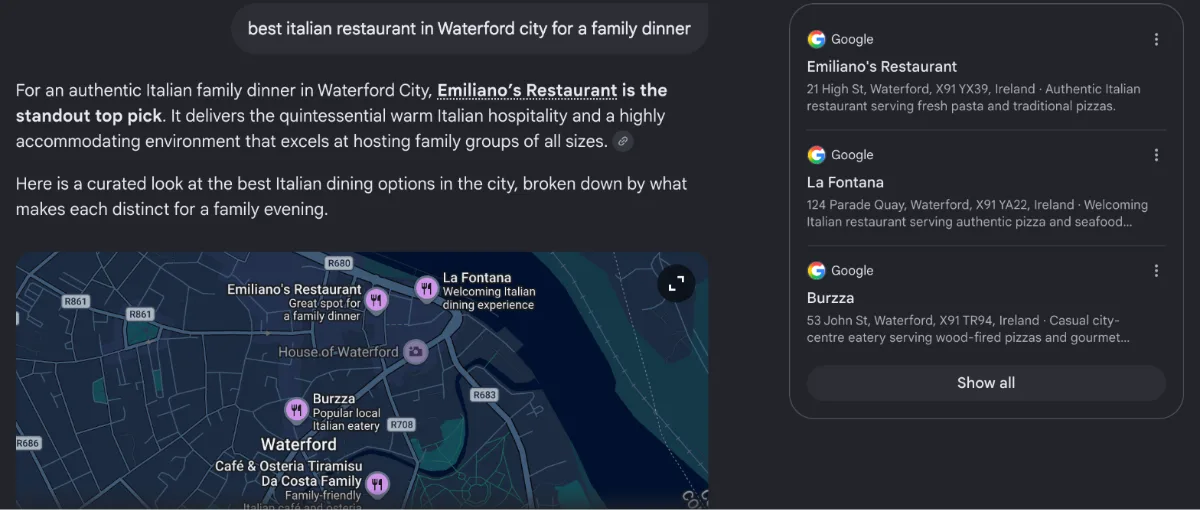
That shift matters because restaurants compete in a category where decisions are immediate, local and highly influenced by trust. If your restaurant isn't clearly understood by AI search systems, you may be overlooked even if your food, service and location are excellent.
For restaurateurs, this isn't a technical exercise. It's a visibility exercise. The goal is to ensure AI systems can answer three basic questions about your business without hesitation: who you are, what you offer, and why you are a credible recommendation.
AI search systems choose restaurants based on clarity, credibility and local relevance
When AI systems assemble an answer, they look for signals that are easy to verify. Restaurants are especially affected because recommendations depend on practical facts: cuisine, location, opening hours, price point, dietary options, reviews, atmosphere and booking availability.
A restaurant is more likely to appear in AI-generated answers when its information is consistent across its website, Google Business Profile, review platforms, local directories and press mentions. It is also more likely to be cited when it has content that describes its offer in plain language rather than relying on vague branding alone.
Clear business identity improves citation chances
AI systems need to recognise your restaurant as a distinct local business. That includes your exact trading name, address, phone number, website, opening hours and service area if relevant. If this information varies across platforms, confidence falls.
Detailed service information helps AI match you to the right query
Diners don't always search by restaurant name. They search by need. They may ask for gluten-free dining, outdoor seating, private dining, pre-theatre menus, Sunday roast, tasting menus or child-friendly restaurants. If your website and profiles don't state these details clearly, AI systems have less evidence to include you in those answers.
Trusted third-party signals strengthen recommendations
Reviews, local press coverage, listings, awards and mentions on respected local websites all help. AI systems tend to favour businesses that are described consistently by multiple credible sources. If you want a deeper explanation of how citation decisions work, see How ChatGPT Search selects which sources to cite.
Your website should explain the restaurant in language a customer would use
Many restaurant websites are visually attractive but weak as information sources. They may have beautiful photography and a booking button, yet say very little about what makes the venue suitable for particular occasions or preferences. AI search systems need more than ambience. They need facts and context.
Your homepage, location page and menu pages should state your cuisine, neighbourhood, dining style, typical price range, dietary accommodations and reasons people choose you. This should be written naturally, for human readers first, but with enough clarity that an AI system can extract meaning from it.
Describe cuisine and dining experience precisely
“Modern dining experience” says very little. “Neighbourhood Italian restaurant in Galway serving handmade pasta, wood-fired pizza and seasonal Irish ingredients” says much more. Precise language gives AI systems usable evidence.
Publish practical details prominently
Include opening hours, booking methods, parking information, accessibility notes, group booking options, private dining availability and dietary support. These details often decide whether a restaurant is recommended for a given prompt.
Keep menu content crawlable and up to date
If your menu exists only as a hard-to-read image or a PDF with little context, AI systems may struggle to interpret it. A text-based menu page is far more useful. Include dish categories, key ingredients and markers for vegetarian, vegan or gluten-free options where relevant.
Local intent is the strongest driver of restaurant discovery in AI search
Restaurant searches are usually tied to place. Even when a user doesn't mention a location, AI systems often infer one from the user's context. That means local relevance is central to restaurant visibility.
Your digital presence should make it obvious where you are and which nearby audiences you serve. This is especially important for restaurants in city centres, tourist areas, business districts and suburban neighbourhoods where competition is high.
Create location-specific content that reflects real demand
A restaurant in Dublin should not only say it is in Dublin. It should mention the district, nearby landmarks and common use cases: business lunches near the IFSC, pre-concert dining near a venue, brunch in Ranelagh, or date-night dining in the city centre. This helps AI systems connect your restaurant to realistic local queries.
Align your Google Business Profile with your website
For a restaurant, the Google Business Profile is the most important source after your own website. In BrightLocal's study of 1.97 million local AI citations (September 2026), 28.6% pointed to a Google Business Profile. Categories, description, opening hours, booking links, photos and review themes should all match your website.
Earn mentions from local publications and community sources
Coverage from local newspapers, city guides, tourism sites, food blogs and event listings can help AI assistants validate your relevance. "Best restaurants in" roundups are worth the most effort: in Muck Rack's analysis (May 2026), 84% of AI citations were earned media. A mention in a respected local source may carry more practical value than a generic national directory listing.
Reviews are one of the strongest trust signals for restaurant recommendations
For restaurants, reviews do more than influence click-through rates. They provide language that AI systems can use to understand quality, atmosphere, service style and suitability for specific needs. A pattern of recent, specific and credible reviews can materially improve your visibility in AI-generated recommendations.
Reviews are particularly useful because they describe your restaurant in the words diners actually use. Google reviews come first; BrightLocal found Yelp, Facebook and Tripadvisor also cited in local AI answers, so keep those profiles current too.
Specific reviews are more useful than generic praise
“Lovely place” is pleasant but limited. “Excellent seafood restaurant near Eyre Square with attentive staff and strong gluten-free options” is a much stronger signal. It contains cuisine, location, service and dietary relevance in one sentence.
Recency matters in hospitality
Restaurants change quickly. Menus evolve, chefs move, standards rise or slip. AI systems are more likely to trust businesses with a steady flow of recent feedback than those relying on older reputation alone.
Review acquisition should be structured and ethical
Ask happy customers for honest reviews at the right moment: after a positive meal, after a private event, or through a follow-up email if you collect bookings directly. For a practical framework, read How to get Google reviews that improve AI citation.
Restaurant content should answer real dining questions directly
Restaurants that want to appear in AI search results should publish content that mirrors how people ask for recommendations. This doesn't mean writing blog posts for the sake of it. It means creating useful pages that answer common decision-making questions.
Good restaurant content reduces ambiguity. It tells both the diner and the AI system exactly when your venue is a fit.
Useful content topics for restaurants
Examples include private dining options, set menus for groups, allergy information, seasonal menus, event dining, business lunch suitability, family dining guidance, and local area pages tied to nearby landmarks or occasions.
Write pages around occasions, not just promotions
A page titled “Private dining in Limerick for birthdays, business dinners and small celebrations” is often more useful than a vague page titled “Events”. Occasion-based language aligns better with AI search prompts.
Answer operational questions before customers need to ask
State whether walk-ins are accepted, whether children are welcome at all times, whether dogs are allowed outdoors, whether there is wheelchair access, and whether large groups need to pre-order. These details are frequently requested in AI search.
Structured data and clean site foundations make restaurant information easier to interpret
Strong AI visibility depends on content and authority, but technical foundations still matter. A restaurant website should be easy to crawl, fast on mobile and structured in a way that clearly labels key business information.
This is where many local businesses benefit from a formal review of their digital presence. An AI search strategy usually starts by identifying gaps in consistency, authority and page clarity.
Use structured business information consistently
Your restaurant name, address, phone number, opening hours, menu URL, reservation link and social profiles should be presented consistently across your site and external listings. Restaurant schema markup is worth keeping accurate for classic search, but treat it as housekeeping: a controlled test of 1,885 pages (Ahrefs, May 2026) found no measurable effect on AI citations.
Make important pages accessible without friction
If menus, booking details or location information are hidden behind scripts, pop-ups or image-only layouts, AI systems may not interpret them properly. Keep essential information available in standard page text, because most AI answer crawlers do not run JavaScript. Check too that robots.txt and your CDN or firewall let those crawlers in.
Audit before you expand
Before investing in more content, check whether your current foundations are sound. HelloWorld typically approaches this through an AI Visibility Audit, followed by an AEO Implementation Programme where needed, then AI Answer Content and ongoing support through an AEO Retainer.
A practical AI search checklist for restaurants improves visibility fastest
The most effective restaurant strategy is usually not complicated. It is disciplined. Start with the basics, fix inconsistencies, and publish content that reflects genuine customer demand.
- Ensure your restaurant name, address and phone number are identical across your website, Google Business Profile and major directories.
- Add a clear text-based menu page with dish categories, dietary markers and current pricing where appropriate.
- State your cuisine, neighbourhood, dining style and price point clearly on the homepage.
- Publish opening hours, booking links, accessibility details and parking information in visible page text.
- Create pages for high-intent occasions such as private dining, business lunches, family meals or pre-theatre dining.
- Collect recent Google reviews that mention specific dishes, service quality, atmosphere and use cases.
- Update your Google Business Profile description, categories, photos and booking options to match your website.
- Seek mentions from local press, food writers, tourism sites and the "best restaurants in" roundups that AI assistants already cite for your area.
- Include nearby landmarks and district references naturally on your location and contact pages.
- Check that key pages load quickly on mobile and do not hide important information in image-only formats.
- Review whether your restaurant is described consistently across Instagram, Facebook, Tripadvisor, Yelp and booking platforms.
- Run an AI search audit to identify where AI systems may be missing, misreading or undervaluing your business.
Restaurants that win in AI search are usually the easiest to verify
The common thread in successful restaurant visibility is not clever wording. It is verifiable clarity. AI search systems are more comfortable recommending businesses they can understand from multiple trustworthy signals.
For restaurateurs, that means treating your website, reviews, listings and local mentions as one joined-up reputation system. If your business is clearly described, consistently presented and regularly endorsed by real customers and credible local sources, your chances of appearing in AI answers improve significantly.
This is particularly valuable for independent restaurants competing against chains and aggregator platforms. AI search can reward specificity and local credibility, which gives well-run local venues a genuine opportunity to stand out.
What is AI search optimisation for restaurants?
AI search optimisation for restaurants is the process of improving your digital presence so AI search systems can confidently recommend your venue in response to dining-related prompts. It focuses on clear business information, strong reviews, useful website content, local relevance and trusted third-party mentions.
How is AI search different from traditional restaurant SEO?
Traditional SEO aims to improve rankings in search results pages. AI search optimisation aims to increase the likelihood that your restaurant is named, summarised or cited directly in AI-generated answers. The overlap is significant, but AI search places even more emphasis on clarity, trust and suitability for specific intents.
Do reviews really affect whether a restaurant appears in AI answers?
Yes. Reviews are a strong trust signal because they provide recent, third-party descriptions of food, service, atmosphere and suitability. Specific reviews that mention cuisine, location, dietary options or occasions are especially useful for AI systems.
What pages should a restaurant add to improve AI visibility?
Useful additions often include a proper menu page, private dining page, group bookings page, allergy or dietary information page, and location-specific pages tied to nearby landmarks or common dining occasions. The right mix depends on how customers search for your venue.
How long does it take to improve restaurant visibility in AI search?
Some improvements, such as fixing inconsistent business details or strengthening key pages, can help quickly. Broader gains usually take longer because review growth, local mentions and citation trust build over time. A structured monthly approach tends to produce the strongest long-term results.