Google AI Overviews are Google’s AI answer box, a summary that can appear at the top of search results to answer a question in plain language using information gathered from different websites. For your business, this means Google may answer a customer’s question before they click any website, so your site needs to provide clear, trustworthy information if you want to be included in that answer or chosen as the next click.
In everyday terms, this is Google trying to do the first part of the search for people. Instead of showing only a list of links, it may show a written answer first. Under that answer, Google usually shows links to the sources it used.
For a local business, this matters because customers often search with practical questions. They might ask who offers conveyancing in Cork, where to book a family-friendly restaurant in Galway, or which shop stocks a certain product near them. If Google shows an AI answer first, your business may win attention there, or lose it to a competitor.
Why Google’s AI answer box matters to local businesses
Your website is no longer competing only for ten blue links. It’s also competing to shape the answer itself. That changes how people discover you.
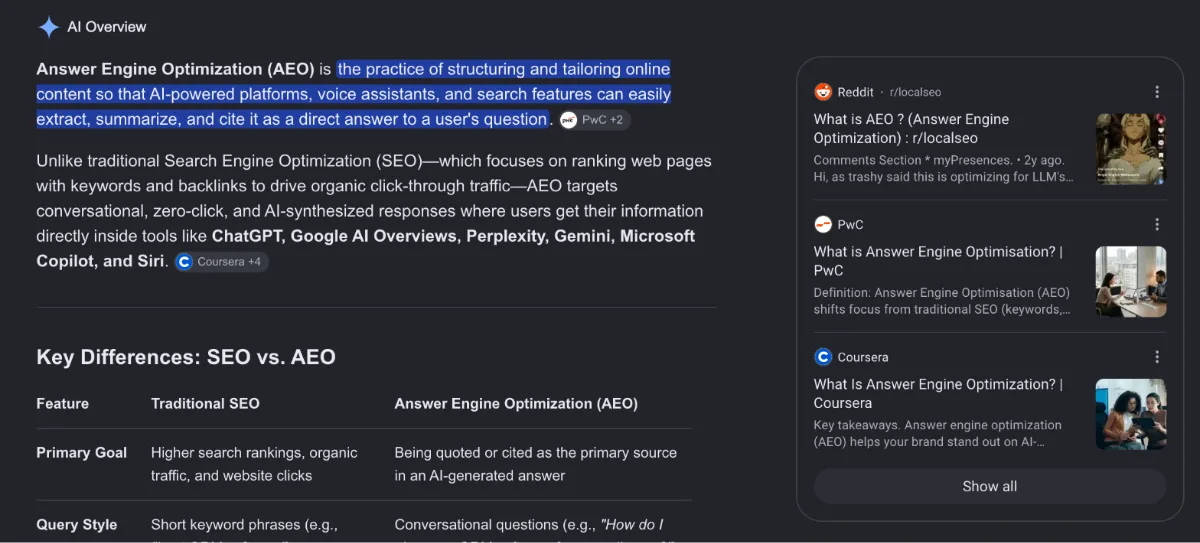
If your site explains your services clearly, shows where you operate, and answers common customer questions, Google has more to work with. If your site is vague, thin, or out of date, Google may use someone else.
This is especially important for local businesses because many searches have local intent. People want fast answers. They want opening hours, service areas, prices, booking details, and whether you are suitable for their situation. If your site makes those details easy to find, you are more likely to be useful in AI search.
How it relates to getting found in AI search
Getting found in AI search means making your business easy for AI readers, the automated systems that read websites, to understand and trust. Google’s AI answer box is one example of this shift.
You don’t optimise for it by using tricks. You optimise by being clear. Put the important facts on the page. Use plain headings. Answer real customer questions. Keep your contact details consistent. Make sure your pages are indexed in Google’s phone book, which means Google can find and store them. Google says there are no extra requirements beyond that: an indexed page that is eligible to show a snippet can appear.
You may hear that schema, your machine-readable business card, is the way in. It is worth keeping accurate, but it is basic upkeep, not a lever. A controlled test on 1,885 pages found no measurable effect on AI citations from adding it (Ahrefs, May 2026), and Google says no special markup is needed. Your Google Business Profile and your reviews matter far more for a local business.
Your site should also have a sitemap, your site’s table of contents, so search engines can find your pages more easily. And it should load well on mobile. Core Web Vitals, how fast your site feels, can affect how usable your site is for visitors.
A practical example
Imagine you run a dental clinic in Dublin. A potential patient searches, “How much is teeth whitening in Dublin and how long does it take?” Google may show an AI answer box with a short summary pulled from several websites.
If your website has a clear page called “Teeth whitening”, lists a price range, explains the process, gives a typical appointment length, and states where your clinic is based, your page is more useful to that search. Google may cite it in the answer box. Even if it does not, a clear page gives you a better chance of being the link the person clicks next.
The same idea applies if you are a solicitor, restaurant, retailer, or trades business. Clear answers help customers. They also help AI search systems understand when to show your business.
What to do next
Start with your most important customer questions. Create or improve pages that answer them directly. Include your location, service area, pricing approach, and what makes you relevant. Keep each page focused on one topic.
Then check the basics. Make sure Google can access your pages and that nothing important is set to noindex or nosnippet. Make sure your business details match across your website and Google Business Profile. Then watch the Generative AI report in Search Console: since 31 August 2026 it shows how often your pages appear in AI Overviews and AI Mode, as impressions only, with the two combined (Google).
Related terms
- AI Search Optimisation
- Structured Data
- Knowledge Graph
- Indexing
FAQs
Do Google AI Overviews replace normal search results?
No. Google still shows regular search results. The AI answer box can appear above them for some searches. That means your website still matters, but the way people choose what to click is changing.
Can I pay to appear in Google’s AI answer box?
There is no standard paid placement that guarantees inclusion in Google AI Overviews. The better approach is to publish clear, helpful, trustworthy content that answers the searcher’s question well.
How do I improve my chances of being included?
Focus on useful pages that answer real customer questions. Add clear business details. Keep your Google Business Profile complete and your reviews recent. Keep your pages genuinely updated, not just re-dated. In short, make your website easier for both people and AI readers to understand.